Appointments, reminders and patient history for a multi-doctor clinic
Online booking against each doctor's real schedule, WhatsApp reminders, patient records found by phone number and a clear day sheet for the front desk.
- Type
- Web Applications
- Industry
- Healthcare & Clinics
- First phase
- 3 to 5 weeks
The situation
A fictional multi-specialty clinic has five doctors working different days and hours, one front desk and a single landline. Appointments are written in a paper diary, patient files are kept in a cupboard by date of first visit, and review visits depend on the receptionist remembering to call. Mornings start with a queue at the counter and a phone that does not stop ringing.
The clinic does not need a hospital information system. It needs the front desk to stop being the bottleneck, and doctors to see a patient's history before the patient sits down. Because the records are medical, how the data is held matters as much as what the software does.
Fictional scenario, synthetic data. The company does not exist and no figures here describe a real deployment. The approach and features are real; the interfaces are illustrations.
Why this is difficult
- Every appointment is booked by phone, so the line is busy exactly when patients want to call
- Doctors' schedules differ by day, and double bookings are found when both patients arrive
- Patient files are searched by hand, and returning patients are often given a new file
- Review visits and repeat tests are missed because reminders depend on memory
- No-shows leave gaps in a doctor's day that could have gone to someone waiting
- The day's consultations and collections are added up from slips at closing time
- Medical records sit in an unlocked cupboard with no record of who has looked at them
How we would build it
We would start with booking and the day sheet, because that is where the front desk loses most of its time, and build the patient record underneath so every booking attaches to one person. Privacy is designed in from the first screen rather than added later.
- 01
Doctor schedules and slot rules
Each doctor's days, hours, slot length and breaks are set once, with leave and holidays blocking slots automatically, so the booking screen only offers real availability.
- 02
Online and WhatsApp booking
Patients pick a doctor and a free slot from the clinic website or a WhatsApp link, confirm with a one-time code sent to their phone and receive an instant confirmation.
- 03
Reminders that reduce no-shows
A WhatsApp reminder the evening before and on the morning of the visit, with a link to confirm, reschedule or cancel, so freed slots reopen for others.
- 04
Patient record by phone number
One record per patient, found by phone number or name, with family members linked under the same number, and visit history, notes, prescriptions and uploaded reports on one timeline.
- 05
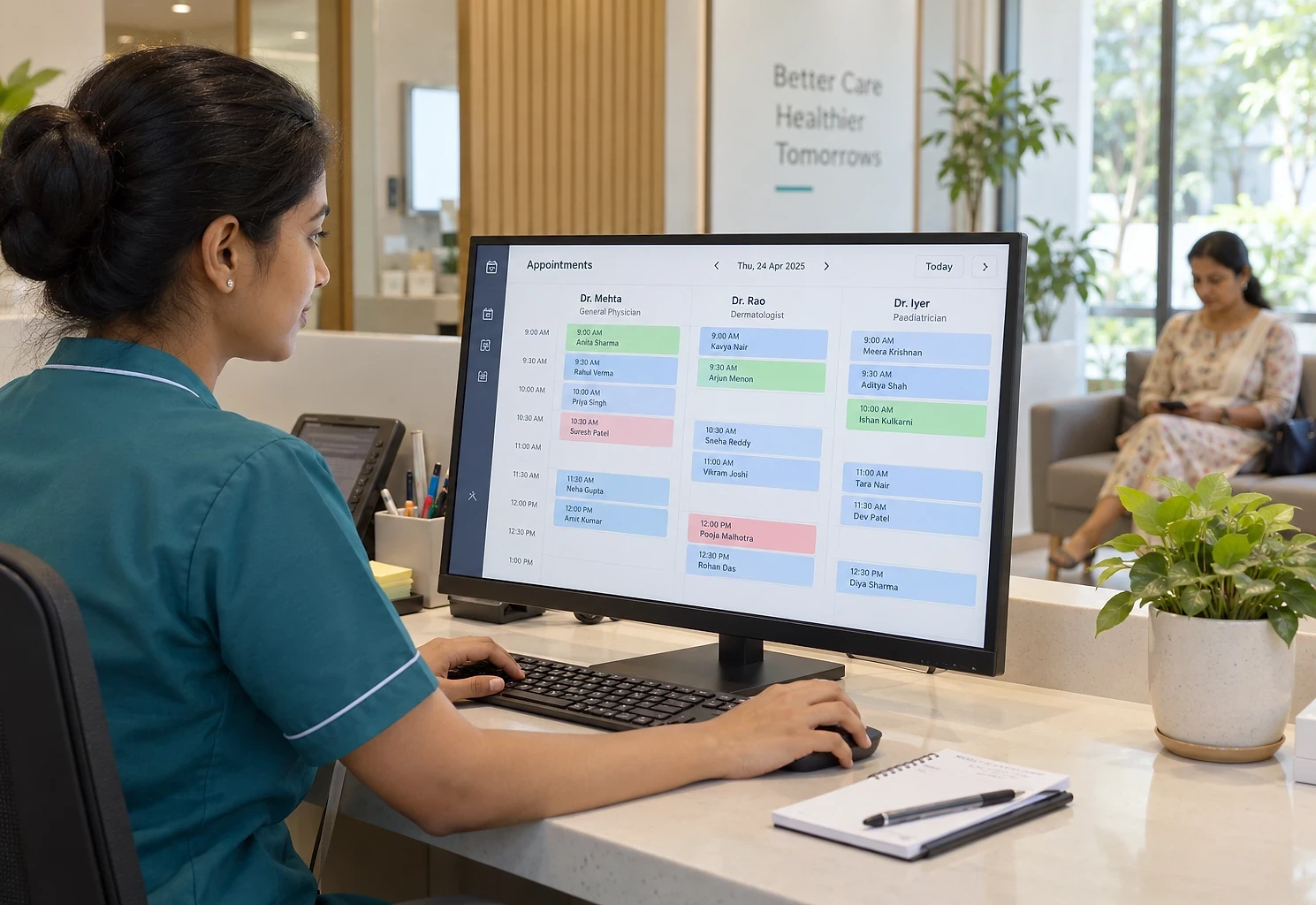
Day sheet for the front desk
Today's appointments by doctor with arrived, waiting and done status, walk-ins added in a tap, and a simple end-of-day summary of consultations and collections.
- 06
Follow-ups and recalls
Doctors set a review date or repeat test during the visit; the system sends the reminder and lists due recalls for the front desk.
- 07
Patient data handled properly
Role-based access so reception sees appointments while only doctors see clinical notes, an audit log of every record opened, encrypted storage, data hosted in India, and patient consent recorded in line with the DPDP Act 2023.
Recognise this problem?
Tell us how it works in your business. You get a written plan and a fixed price for the first phase.
What it looks like
Drawn rather than screenshotted, so nothing here can be mistaken for a real client system. Every figure on the screen is sample data, not a result.
What it would be built with
The final choice depends on what the business already runs.
- Application
- Next.jsTypeScriptPostgreSQLMobile-first front-desk screens
- Messaging
- WhatsApp Business APISMS gatewayPhone OTP
- Security & privacy
- Role-based access controlAudit loggingEncryption at rest and in transitIndia-region cloud hosting
- Integration
- Payment gateway (UPI and cards)Website booking widgetReport storage
How a single item moves through the system
- 1
Patient books
From the website or WhatsApp, the patient chooses a doctor and a slot and confirms with a code sent to their phone.
- 2
Record matched
The phone number finds the existing record or creates a new one, with consent captured on the first booking.
- 3
Reminded
Reminders go out the evening before and the morning of the visit; a cancellation reopens the slot.
- 4
Arrives
Reception marks the patient as arrived on the day sheet and the doctor sees them in the queue.
- 5
Consultation
The doctor opens the history, records notes and a prescription, and sets a review date if one is needed.
- 6
Billed and followed up
A receipt is issued, the day's summary updates and the review reminder is scheduled automatically.
What this kind of system tends to change
Described qualitatively and deliberately so. We have not deployed this scenario, so quoting a percentage improvement would be inventing evidence.
- 1
A front desk that is not tied to the phone
When most bookings and reschedules happen online, reception time goes to the patients standing at the counter.
- 2
Fewer empty slots
Reminders with an easy cancel link free slots early enough to offer them to someone else, rather than discovering them empty.
- 3
History before the patient sits down
Doctors see previous visits, prescriptions and reports in one place instead of waiting for a file to be found.
- 4
Care that continues
Review visits and repeat tests are prompted automatically, so follow-up no longer depends on someone remembering.
- 5
Patient data you can account for
Access by role, a record of who opened what, and data held in India give the clinic a clear answer when a patient asks how their information is handled.
Services and solutions behind this
Custom Web Applications
Internal tools and business systems built around your actual process instead of forcing you into someone else's.
Website Development
Fast, well-structured business websites that explain what you do and turn visitors into enquiries.
Booking & Appointment System
Online booking that respects your real availability, with reminders that reduce no-shows.
Customer Portal
A login area where customers check their own orders, invoices, documents and requests.

Is this close to your situation?
If this scenario resembles what happens in your business, we can have a much more specific conversation. Tell us how it works today and we will tell you what we would change first.
The first conversation is free, with no obligation.