One stock figure across the shop, the website and the marketplace
An online store for an existing shop, with one stock position kept in step across the shop counter, the website and a marketplace.
- Type
- Ecommerce
- Industry
- Retail & Ecommerce
- First phase
- 4 to 6 weeks
The situation
A fictional home furnishings retailer has two shops and sells on one marketplace. Its own website is a catalogue with a phone number. Stock is counted in the billing software at the shops, updated on the marketplace by hand each evening, and items regularly sell online after the last piece has gone over the counter. The owners want to sell properly from their own website without making the stock problem worse.
Adding a website as a third channel only helps if stock stays right across all three. Otherwise every new sale is another chance to oversell, cancel and disappoint a customer. The store and the stock sync have to be designed together.
Fictional scenario, synthetic data. The company does not exist and no figures here describe a real deployment. The approach and features are real; the interfaces are illustrations.
Why this is difficult
- The shop billing software, the marketplace and the website each hold a different stock figure
- Marketplace stock is updated by hand once a day, so overselling is routine
- Cancelled orders damage the seller rating on the marketplace
- The current website cannot take orders or payments
- Online orders are retyped into billing for invoicing
- Walk-in and online customers are separate lists, so repeat buyers go unrecognised
- Sales by product and channel are pieced together at month end
How we would build it
We would treat stock as the core of the project and the website as one of three channels reading from it. The billing software at the shops stays; the new system sits beside it, holds the single stock position and pushes changes to the website and marketplace as each sale happens.
- 01
Online store
A fast, mobile-first store built around the catalogue, with variants, collections, delivery rules by pincode, and UPI, card and cash-on-delivery payments.
- 02
Single stock position
One stock figure per item and location, reduced by every sale wherever it happens and pushed to every channel within moments.
- 03
Shop and marketplace connectors
Sales from the shop billing software and orders from the marketplace are read automatically, so stock changes without anyone typing.
- 04
Safety buffers
A small reserve per item can be held back from online channels, so the last piece on display is not sold twice.
- 05
One order queue
Website and marketplace orders arrive in one list for picking, packing, invoicing and courier booking, with tracking sent to the customer.
- 06
One customer record
Shop and online purchases are linked by phone number, so repeat buyers are recognised and can receive offers on WhatsApp.
- 07
Sales by channel
Daily sales, margin and slow-moving stock by product, shop and channel on one dashboard.
Recognise this problem?
Tell us how it works in your business. You get a written plan and a fixed price for the first phase.
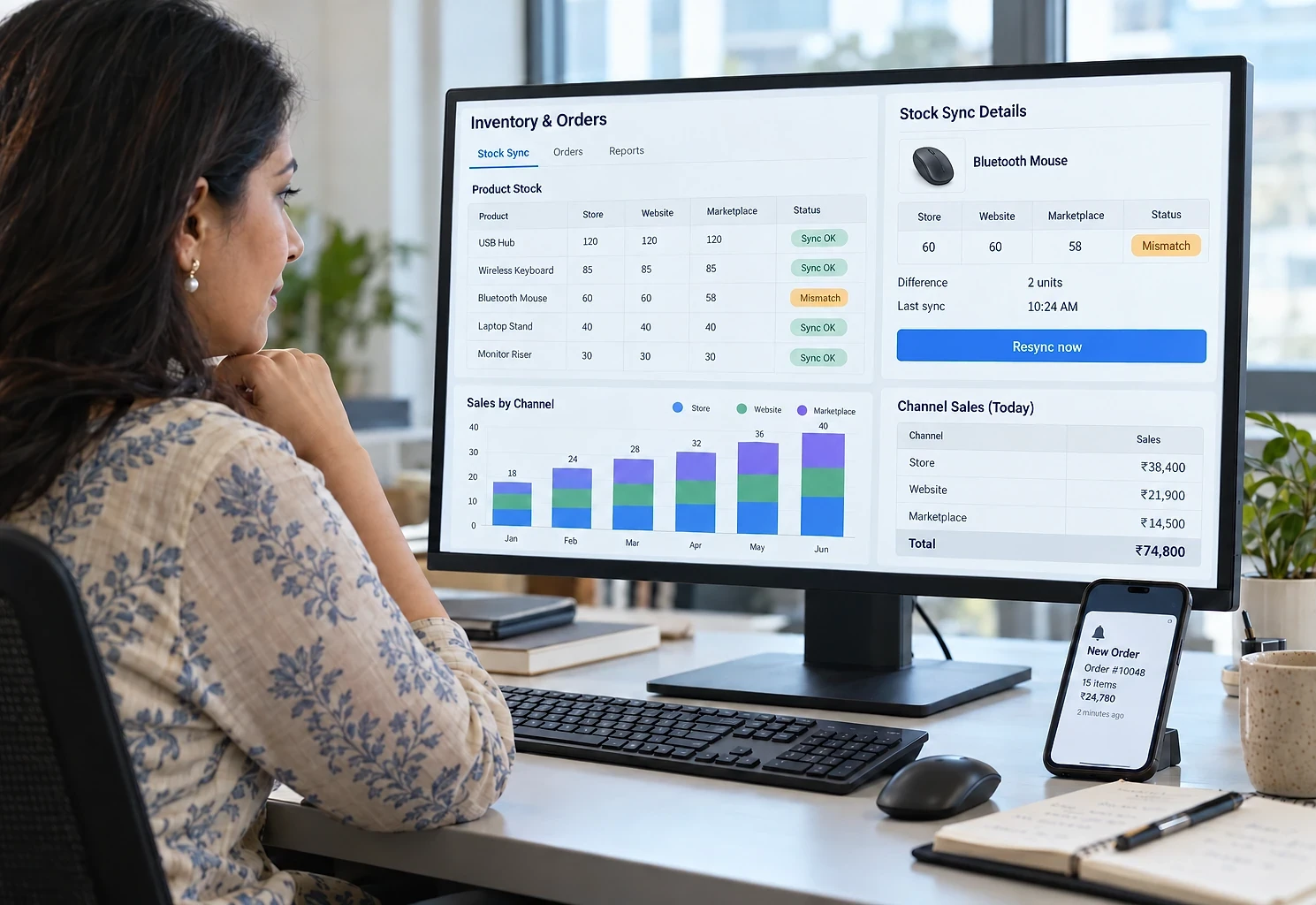
What it looks like
Drawn rather than screenshotted, so nothing here can be mistaken for a real client system. Every figure on the screen is sample data, not a result.
What it would be built with
The final choice depends on what the business already runs.
- Store
- Next.js storefrontHeadless commerce or a custom cataloguePayment gateway (UPI, cards, COD)Search-friendly product pages
- Stock & orders
- PostgreSQLEvent-driven stock updatesJob queuesRetry handling
- Integration
- Shop billing softwareMarketplace seller APIsCourier APIsWhatsApp Business API
- Reporting
- Sales dashboardScheduled summaries
How a single item moves through the system
- 1
Sale happens
An item sells at the counter, on the website or on the marketplace.
- 2
Stock updated
The single stock position reduces for that item and location.
- 3
Channels refreshed
The new figure is pushed to the website and the marketplace, respecting any safety buffer.
- 4
Order queued
Online orders land in one queue for picking, invoicing and courier booking.
- 5
Customer informed
The customer receives confirmation and tracking on WhatsApp or email.
- 6
Reviewed
Sales, margin and slow-moving stock are visible by product, shop and channel the next morning.
What this kind of system tends to change
Described qualitatively and deliberately so. We have not deployed this scenario, so quoting a percentage improvement would be inventing evidence.
- 1
Fewer oversold items
Stock that updates across channels as each sale happens removes the main cause of cancellations.
- 2
A healthier marketplace rating
Fewer cancellations protect the seller rating that marketplace visibility depends on.
- 3
Selling from your own website
Orders through your own store build a direct relationship with the customer rather than the marketplace's.
- 4
No retyping between systems
Orders flow into one queue with invoices and courier bookings instead of being copied by hand.
- 5
Customers recognised wherever they buy
One record across shop and online makes repeat buyers visible and reachable.
Services and solutions behind this
Ecommerce Development
Online stores built around your catalogue, payments and delivery, not a generic template.
API & System Integrations
Connecting the systems you already run so data moves between them without a person in the middle.
Inventory & Dispatch Tracker
Live stock positions across every store and warehouse, with alerts before you run out and a record of what left.
Order Management System
One system tracking every order from enquiry to delivery, whichever channel it arrived through.


Is this close to your situation?
If this scenario resembles what happens in your business, we can have a much more specific conversation. Tell us how it works today and we will tell you what we would change first.
The first conversation is free, with no obligation.