Every order in one place, from enquiry to delivery
Orders arrive by email, phone, WhatsApp, your website and marketplaces. An order management system puts them in one queue with one status model, so nothing is missed and everyone sees the same picture.
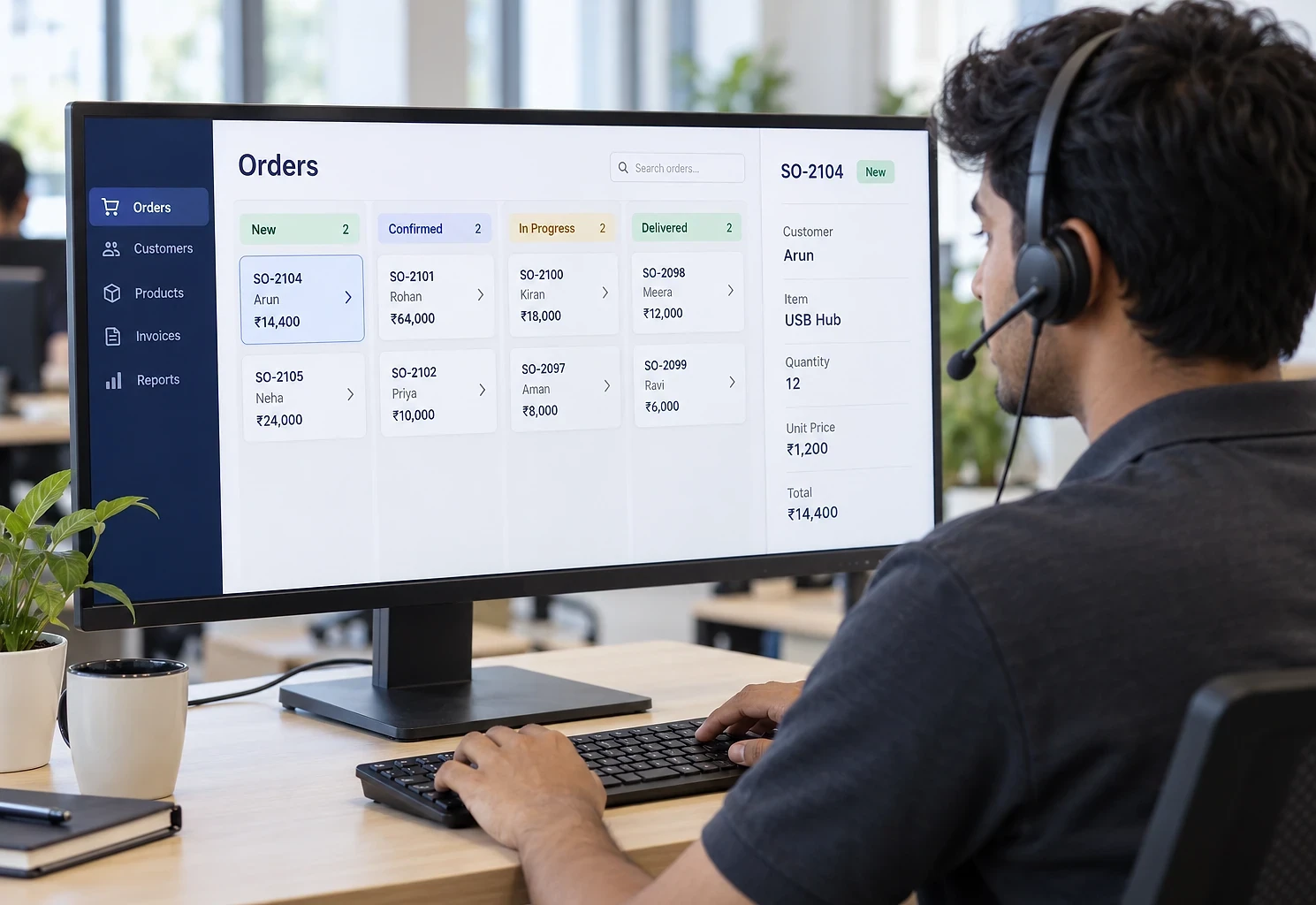
- First module built in
- 6 to 10 weeks
- Order sources
- Email, phone, WhatsApp and website
- Hands over to
- Your existing accounting software
What this addresses
Order handling breaks down as channels multiply, and the single source of truth becomes a spreadsheet that is only right if everyone remembers to update it.
- Orders from several channels are consolidated by hand into one sheet
- Nobody can say with confidence how many orders are pending right now
- Order details are retyped into dispatch and accounting systems
- Partial dispatches and back orders are tracked informally
- Errors surface at dispatch, when correcting them is expensive
Need stock tracking as well? Most distributors start with order management and add inventory as phase two.
How it is put together
A single order record created once, whatever channel it arrived through, that moves through the stages your business uses. Every stage change is recorded with who made it and when. Dispatch, invoicing and customer notification all work from that one record rather than from copies.
What the system contains
Modules are delivered in phases, starting with the one that removes the most work. You own the finished system, code and data included.
- 01
Order capture
Manual entry, website orders and bulk upload, plus optional automatic reading of order emails and PDFs (see Email and Document Automation). All arrive in the same queue.
- 02
Order processing and status
Configurable stages matching your process: received, confirmed, in production, ready, dispatched, delivered. Each with its own rules and responsible role.
- 03
Stock check at confirmation
Available quantity checked and reserved when an order is confirmed, with clear handling of shortfalls and back orders. Full warehouse stock control is the Inventory tracker's job.
- 04
Dispatch and delivery
Packing lists, dispatch notes, courier booking, tracking numbers captured against the order and delivery confirmation recorded.
- 05
Invoicing
GST-compliant invoice generated from the order with correct tax treatment, either within the system or pushed to your accounting software.
- 06
Customer updates
Automatic confirmation, dispatch and delivery messages by email or WhatsApp, so customers stop needing to ask.
- 07
Reporting
Pending orders, ageing, dispatch performance, and order value by customer, product and channel.
Who it suits, and how it adapts
Integration effort depends on what each system offers. We assess it before quoting.
Who this suits
- Manufacturers handling both trade and direct orders
- Distributors and wholesalers with repeat customers
- Businesses selling across their own website and marketplaces
- Caterers, print shops and studios taking custom orders
- Any business whose order tracking has outgrown a spreadsheet
What it can connect to
- Accounting and ERP systems for invoicing and financial posting
- Your website, Shopify or marketplaces for incoming orders
- Courier services for booking and tracking
- Payment gateways for payment status
- WhatsApp Business and email for customer updates
How it can be customised
- Order stages and rules that mirror your existing process
- Approval requirements for credit limits, discounts or large orders
- Customer-specific pricing and payment terms
- Partial dispatch, back order and cancellation handling
- Your own templates for orders, packing lists and invoices
From first call to first module
The first module is usually built in 6 to 10 weeks. Durations depend on scope, integration complexity and how quickly access and decisions are available.
- 0145 min
Free scoping call
We follow one order end to end as it happens today, through every channel and every hand it passes through.
- 021 week
Status model and specification
Stages, roles, rules and documents defined and agreed in writing.
- 036-10 weeks
Build and data migration
The system is built and open orders are migrated from existing spreadsheets.
- 042-3 weeks
Parallel run
Both systems run together until the team is confident, then the spreadsheet is retired.
Order Management System questions
Hosting, backups and updates after launch:
Cloud Hosting & SupportNot covered here?
Ask us directlyDo we have to stop taking orders on WhatsApp?
No. Customers will use whatever channel they prefer. The point is that a WhatsApp order is entered into the system straight away and tracked there, rather than living in a chat thread. At higher volumes those messages can be read automatically so entry is not manual.
Can it work alongside our accounting software?
Yes, and that is usually the right split. The order system handles operations and status; the accounting system remains the financial record. We connect them so invoices and payment status flow between the two without retyping.
What about partial dispatches?
Handled explicitly. An order can be dispatched in parts, with each dispatch tracked separately and the remaining quantity shown as pending. Invoicing can follow either the dispatch or the full order, depending on how you work.
How long before the team is comfortable with it?
Most staff are productive within a day or two, because the flow mirrors what they already do. The parallel run exists mainly to build confidence in the data rather than to teach the screens.
What does it cost to run once it is built?
Mainly hosting, which we size to your order volume, plus WhatsApp message fees and courier API charges if you use them. Those are billed at cost by the provider, not marked up. Ongoing upkeep is optional, under our Cloud Hosting & Support service.
Around the order management system
Services behind it
Often combined with

Follow one order with us
Walk us through how a single order travels today, from the first message to delivery. We will map where it gets retyped or lost and what the system would change first.
The first conversation is free, with no obligation.