Field work recorded on site, not reconstructed back at the office
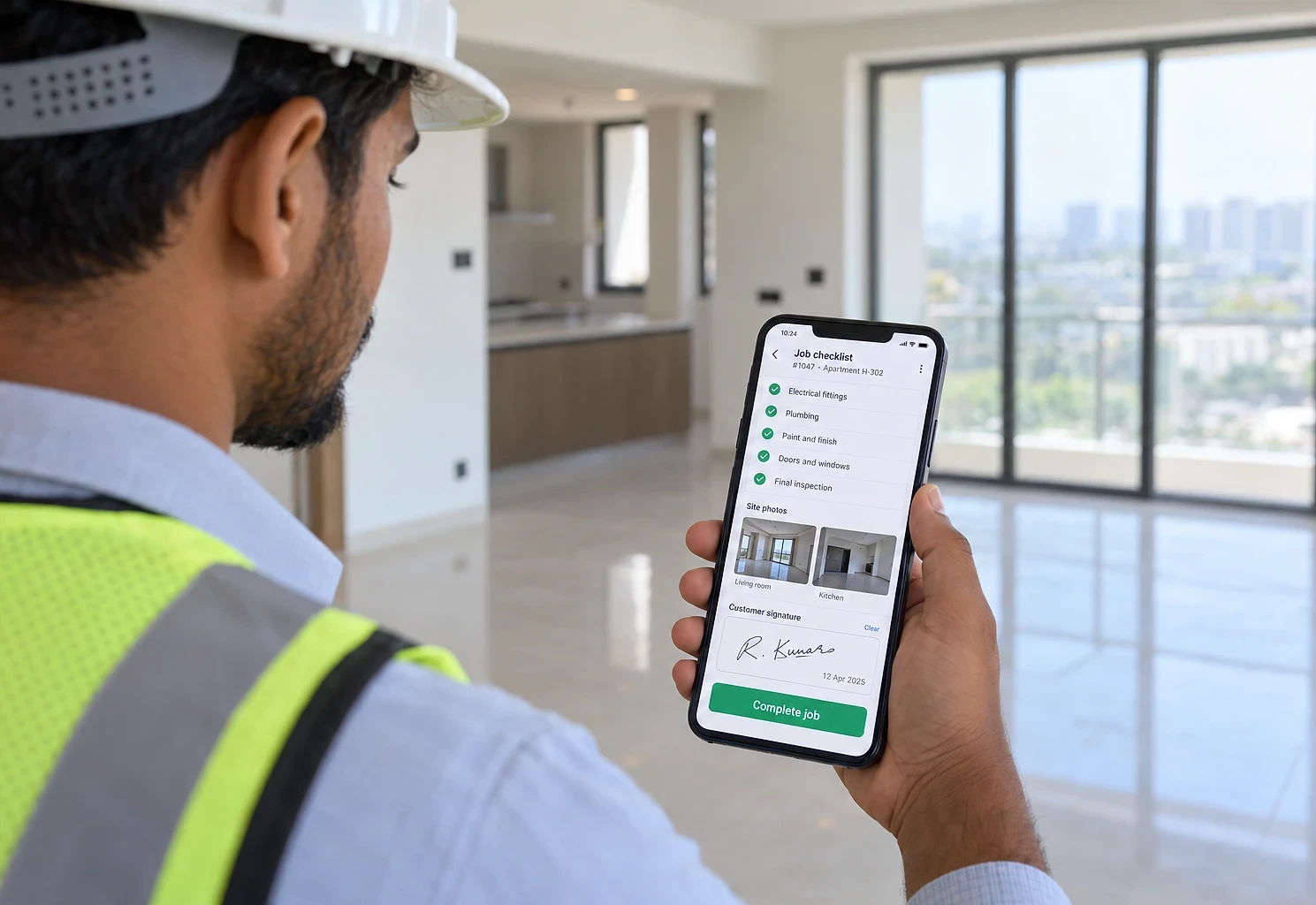
A mobile app for site and service teams: jobs assigned to each person, check-in with location, photos, checklists and customer signatures, working offline.
- Type
- Mobile Apps
- Industry
- Real Estate & Construction
- First phase
- 4 to 6 weeks
The situation
A fictional construction and property maintenance company has about twenty site engineers and technicians working across residential projects and completed buildings. Jobs are handed out on a morning call, progress is reported as WhatsApp photos, inspection checklists are filled in on paper and handed in at the end of the week, and customers sign a printed job sheet that sometimes never reaches the office.
The work itself is done well. What goes missing is the record of it: which job was done, by whom, when and with what evidence. That record matters for billing, for disputes with customers and for knowing what is pending tomorrow. Many sites also have weak or no mobile signal.
Fictional scenario, synthetic data. The company does not exist and no figures here describe a real deployment. The approach and features are real; the interfaces are illustrations.
Why this is difficult
- Jobs are assigned on a morning call, so priorities change by word of mouth
- The office cannot see who is on which site without calling around
- Progress photos sit in WhatsApp chats with no link to the job or location
- Inspection and handover checklists are on paper and arrive days later
- Signed job sheets are lost or illegible, which weakens billing and warranty claims
- Basements, new towers and outlying sites often have no mobile signal
- Supervisors learn about delays and missing materials only at the weekly review
How we would build it
The app has to be quicker than WhatsApp for the person on site, or it will not be used. So each job opens to a short, ordered set of steps, works without signal and syncs when it can. The office view is built from what the field records, not the other way round.
- 01
Job assignment
Supervisors assign jobs to each engineer or technician with address, scope, priority and due date, and the day's list appears on their phone in order.
- 02
Check-in with location
On arrival the user checks in and the app records the time and location, so the office sees who is where without phoning.
- 03
Photos against the job
Before, during and after photos taken inside the app are stamped with time and location and filed against the job and the specific checklist item.
- 04
Configurable checklists
Inspection, snag, handover and maintenance checklists set up by the office, with required fields, pass or fail and notes for each item.
- 05
Customer signature
The customer or site in-charge signs on the phone screen to accept the work, and a PDF job report is sent to them automatically.
- 06
Works offline
Jobs, checklists and photos are stored on the phone and sync when signal returns, so a basement or remote site is not a problem.
- 07
Office dashboard
Jobs by status, overdue work, open snags and materials requested from site, with each job's full record a click away.
Recognise this problem?
Tell us how it works in your business. You get a written plan and a fixed price for the first phase.
What it looks like
Drawn rather than screenshotted, so nothing here can be mistaken for a real client system. Every figure on the screen is sample data, not a result.
What it would be built with
The final choice depends on what the business already runs.
- Mobile
- React NativeOffline storage with background syncCamera and GPSSignature capture
- Back end
- Node.jsPostgreSQLObject storage for photosPDF report generation
- Office
- Next.js web dashboardRole-based access controlJob scheduling
- Integration
- Maps and navigation linksWhatsApp Business APIEmail
How a single item moves through the system
- 1
Job assigned
The supervisor creates or schedules a job and assigns it, and it appears on the engineer's phone.
- 2
On site
The engineer opens the job, navigates to the address and checks in with location.
- 3
Work recorded
Checklist items are completed in order with photos and notes, with or without signal.
- 4
Customer signs
The customer reviews the summary and signs on the screen; a PDF report goes to them by email or WhatsApp.
- 5
Synced
Everything uploads when signal returns, and the job closes in the office view.
- 6
Followed up
Open snags, material requests and overdue jobs appear on the supervisor's dashboard for the next day.
What this kind of system tends to change
Described qualitatively and deliberately so. We have not deployed this scenario, so quoting a percentage improvement would be inventing evidence.
- 1
A record of every visit
Time, location, photos and a signature for each job mean the work done is evidenced rather than remembered.
- 2
Fewer calls to find out what is happening
The office sees check-ins and job status as they happen instead of ringing round.
- 3
A stronger billing and warranty position
A signed report with photos settles most questions about what was done and when.
- 4
Checklists that arrive the same day
Inspection and handover results are available as soon as they sync, rather than at the end of the week.
- 5
Problems raised while they can be fixed
Snags and material shortages reported from site reach a supervisor the same day.
Services and solutions behind this
Mobile App Development
Android and iOS apps for your customers, field staff or internal team, connected to the systems you already run.
Custom Web Applications
Internal tools and business systems built around your actual process instead of forcing you into someone else's.
Complaint & Ticketing System
Every complaint tracked with an owner, a deadline and an escalation path, instead of an email thread.
Approval Workflow System
Route requests to the right approver automatically, with delegation, escalation and an audit trail.

Is this close to your situation?
If this scenario resembles what happens in your business, we can have a much more specific conversation. Tell us how it works today and we will tell you what we would change first.
The first conversation is free, with no obligation.